
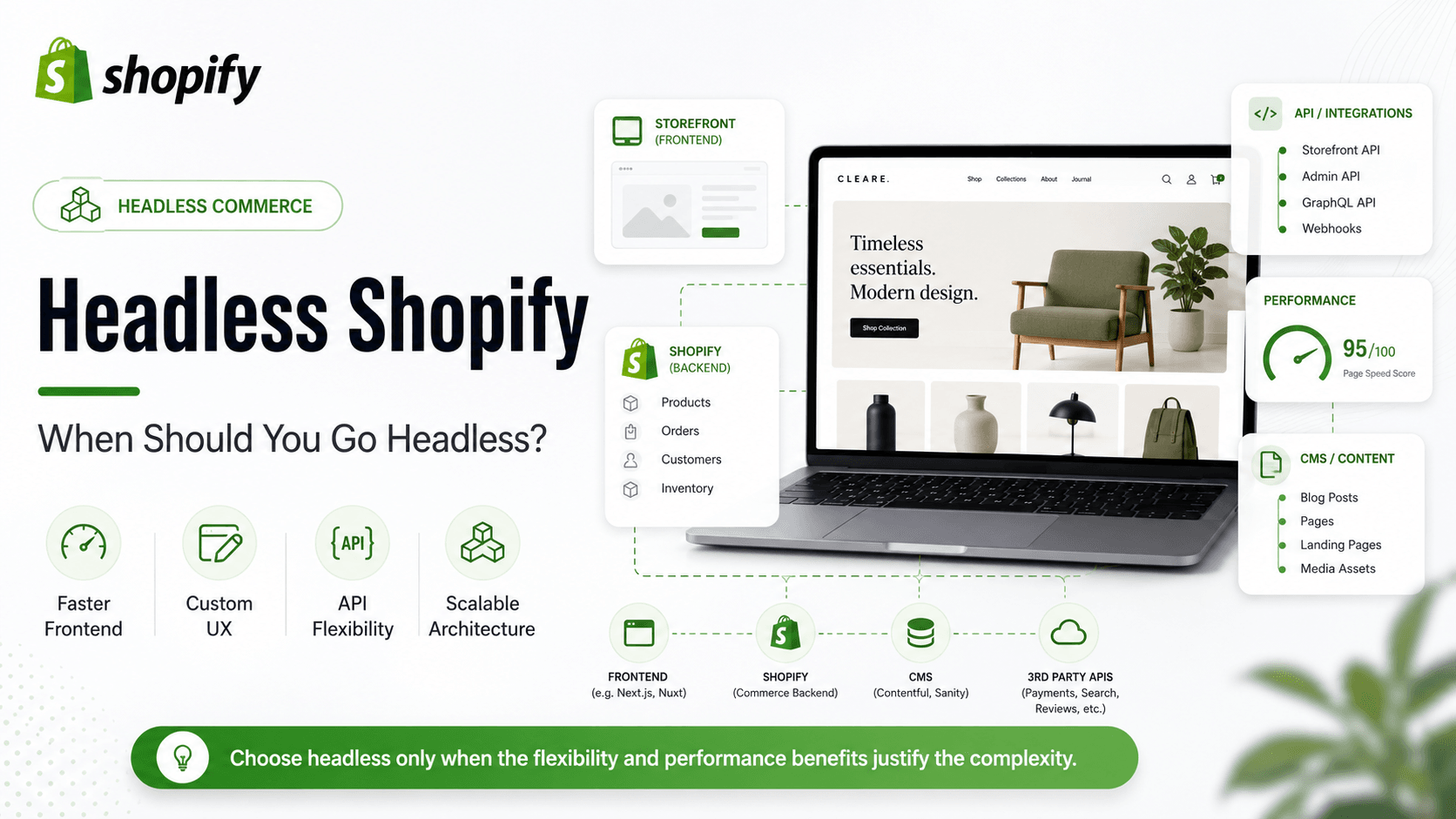
Headless Shopify separates your storefront frontend from Shopify’s commerce backend. In a headless setup, Shopify still handles products, cart, checkout foundations, and commerce data, while a custom frontend — often Next.js or another modern framework — controls presentation and interaction. In 2026, headless is powerful, but it is not automatically the right move.
What headless actually changes
You gain frontend freedom: custom UX, performance tuning, and content experiences that online store themes struggle to express. You also take on more engineering ownership: deployment, rendering strategy, caching, and ongoing frontend maintenance become your responsibility.
When headless makes sense
Consider headless when your brand needs highly distinctive UX, complex content experiences, app-like browsing, or performance targets that a heavily customized theme cannot reach cleanly. It also fits teams that already have frontend engineering capacity and a clear product roadmap.
When you should stay on Online Store
If your main needs are standard merchandising, faster iteration by non-developers, and lower maintenance overhead, a well-built Shopify theme is usually better. Many brands overestimate the gains of headless and underestimate the cost of building and maintaining a custom storefront.
Performance benefits and trade-offs
Headless can improve perceived performance through modern rendering and caching strategies. It can also become slow if APIs, over-fetching, and poor caching are ignored. Performance is not guaranteed by architecture alone — implementation quality decides outcomes.
SEO considerations
SEO can thrive in headless stores when rendering, metadata, canonical rules, sitemaps, and internal linking are engineered carefully. It can also fail when client-side rendering or weak metadata pipelines create indexation problems. Plan SEO architecture before launch, not after rankings drop.
Operational reality for marketing teams
Theme editors are familiar to merchants. Headless often moves more changes into developer workflows or CMS tooling. Make sure your content and campaign teams understand how they will publish landing pages, banners, and seasonal updates after launch.
A decision framework for 2026
Choose headless if custom experience and engineering leverage clearly outweigh maintenance cost. Otherwise invest in theme quality, speed, and conversion. Many successful brands combine a strong Online Store foundation with selective custom apps instead of going fully headless.
XLOXI helps teams evaluate headless Shopify honestly — including architecture planning, Next.js storefronts, and theme-based alternatives that may deliver better ROI.
Project planning realities for headless teams
Budget for design systems, CI/CD, preview environments, analytics parity, and ongoing frontend maintenance. Headless launches that ignore these operational pieces often ship late or become fragile after the first campaign season. Also plan for checkout edge cases, redirects, and SEO parity with the old storefront.
Run a proof of concept around your hardest requirement: personalized landing experiences, complex navigation, or performance on key templates. If the POC does not clearly beat a well-built theme approach, reconsider.
In 2026, headless Shopify is a strategic architecture choice. Make it when product and engineering leadership are aligned, not because the term sounds modern.
XLOXI can help you compare headless and theme-based Shopify options with a clear ROI lens before you commit engineering budget in 2026. The best architecture is the one your team can ship and maintain without slowing marketing velocity.