
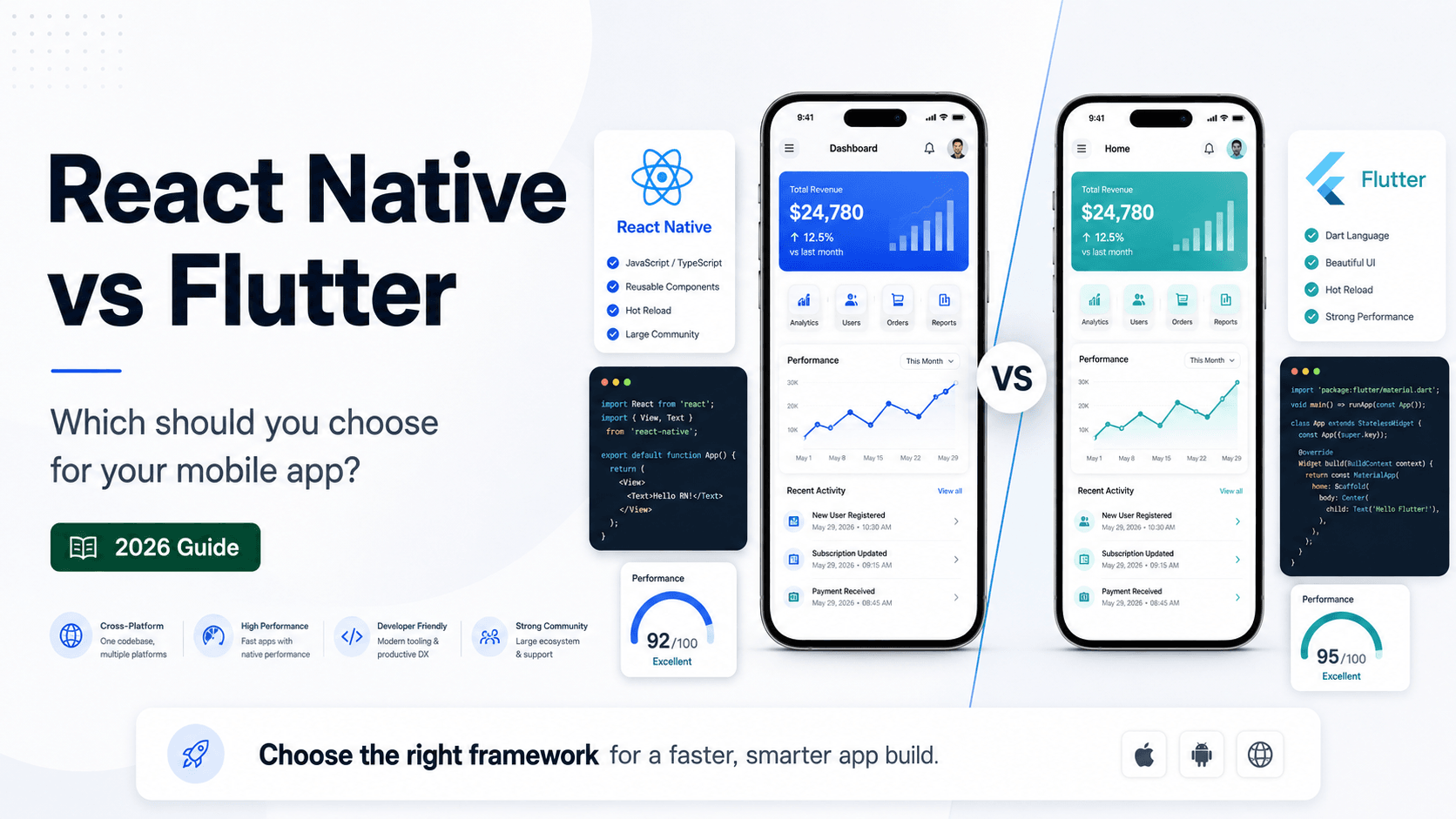
React Native and Flutter remain two of the strongest cross-platform mobile frameworks in 2026. Both can ship high-quality iOS and Android apps from a shared codebase. The better choice depends on your team skills, UI requirements, performance targets, and long-term hiring plan.
React Native in plain terms
React Native lets teams use React and JavaScript or TypeScript patterns familiar to many web developers. That can speed up hiring and shared component thinking across web and mobile. The ecosystem is mature, with broad library support and a large community.
Flutter in plain terms
Flutter uses Dart and draws UI with its own rendering engine. Many teams choose it for consistent UI across platforms and strong performance in design-heavy apps. Flutter’s widget system and tooling are highly productive once the team is comfortable with Dart.
Performance and UI consistency
Both frameworks can feel native when built well. Flutter often shines when you want pixel-consistent custom UI across platforms. React Native can feel excellent too, especially with modern architecture patterns and careful native module use. Performance problems in either stack usually come from poor implementation, not the logo on the framework.
Developer experience and hiring
If your company already runs on React for web, React Native can reduce context switching and widen the hiring pool. If you are building a mobile-first product team and value Flutter’s UI system, Dart learning cost may be worthwhile. Choose the ecosystem your organization can staff and maintain for years.
Ecosystem and native integrations
Payments, analytics, push notifications, camera flows, and offline storage all need reliable libraries or native bridges. Evaluate the exact integrations your roadmap needs. A framework win on paper means little if a critical native dependency is weak for your use case.
When to choose React Native
Choose React Native when JavaScript/TypeScript talent is central to your company, when web and mobile share product thinking, and when ecosystem familiarity matters more than Flutter’s rendering model. It is often a strong fit for product teams already invested in React.
When to choose Flutter
Choose Flutter when you want highly controlled custom UI, strong cross-platform visual consistency, and a team ready to standardize on Dart. It is often excellent for design-forward apps and teams building mobile as the primary surface.
A practical decision process for 2026
List must-have native integrations, UI complexity, hiring constraints, and timeline. Prototype the riskiest screen or integration in both stacks if the decision is close. Then commit fully — the cost of switching later is high.
XLOXI helps businesses plan and build mobile products with the framework that fits their team and roadmap, including React Native and Flutter delivery for modern product requirements in 2026.
Delivery model and long-term maintenance
Cross-platform success depends on release discipline: shared design tokens, automated tests for critical flows, and clear ownership of native modules. Either framework can fail without those practices. Discuss maintenance budgets honestly before choosing, because mobile apps are never truly “finished.”
Also consider offline behavior, accessibility, and analytics requirements early. These cross-cutting concerns influence architecture more than fan debates about frameworks. A short architecture spike that validates navigation, forms, and one native integration often prevents months of rework.
If your roadmap includes a Shopify-powered commerce app, evaluate how product, cart, and checkout webviews or headless APIs will fit the chosen framework. Commerce complexity can matter more than UI kit preference.
In 2026, XLOXI recommends choosing the framework your team can staff, ship, and support with quality — then investing in product excellence rather than endless framework comparison.